Big Mysteries of the Universe
In the last decade, we’ve taken photos of a black holes, peered into the heart of atoms and looked back at the birth of the Universe. And yet, there are yawning gaps in our understanding of the Universe and the laws that govern it. These are the mysteries that will be troubling physicists and astronomers over the next decade and beyond.

_________________________________________________________________
Why is there something rather than nothing?
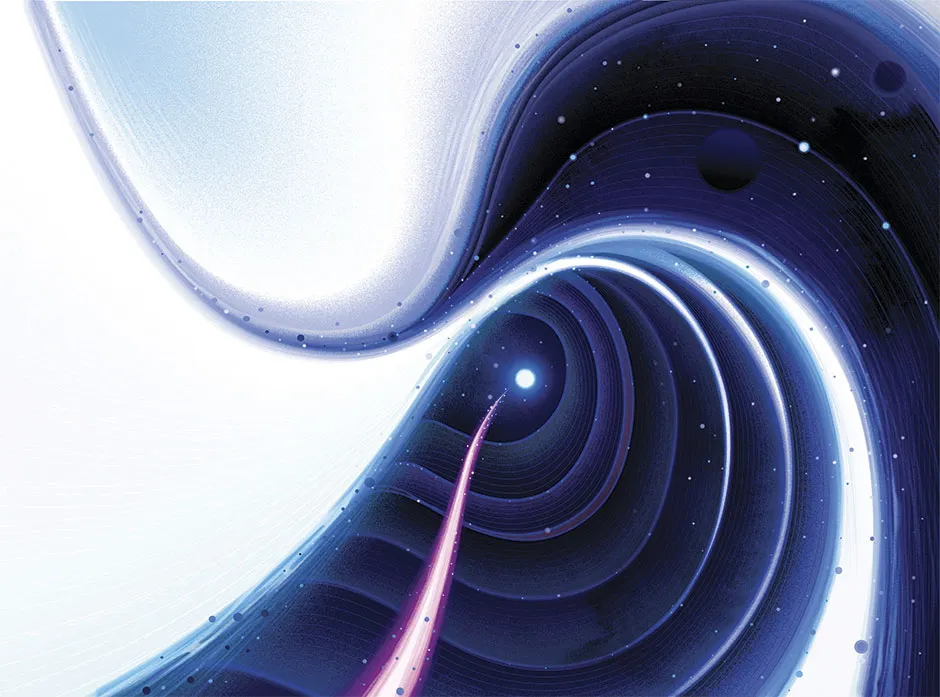
In the beginning, according to the standard picture of cosmology, was the ‘inflationary vacuum’. It had a super-high energy density and repulsive gravity, causing it to expand. The more of it there was, the greater the repulsion and the faster it expanded. In common with all things ‘quantum’, this vacuum was unpredictable. At random locations, it decayed into ordinary, everyday vacuum. The tremendous energy of the inflationary vacuum had to go somewhere.
And it went into creating matter and heating it to a blisteringly high-temperature – into creating big bangs. Our Universe is merely one such Big Bang bubble in the ever-expanding inflationary vacuum.
Remarkably, this whole process could have started with a piece of inflationary vacuum with a mass equivalent to a bag of sugar. And, conveniently, the laws of physics – specifically, quantum physics – permit such matter to pop into existence from nothing. Of course, the next obvious question now is: where did the laws of physics come from?
_________________________________________________________________
Why is there a monster black hole in the heart of every galaxy?
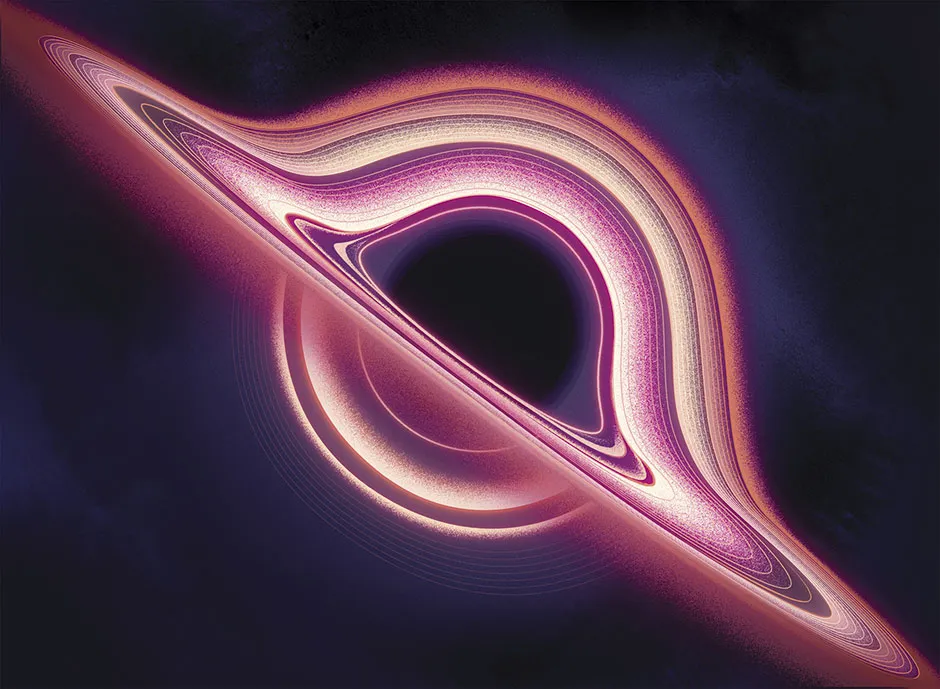
There are about two trillion galaxies in our Universe and, as far as we know, almost every one contains a central supermassive black hole. They range in size from monsters, weighing almost 50 billion times the mass of the Sun, to the 4.3-million-solar-mass tiddler known as Sagittarius A* in the core of our Milky Way (one solar mass = mass of our Sun). But how they got there is one of the great unsolved mysteries of cosmology.
We know that a stellar black hole forms in a supernova explosion in which the core of a star implodes. But nobody knows how a supermassive black hole forms.
For most of cosmic history, the centres of galaxies have been where a lot of matter is confined in a small volume. It could be the case that supermassive black holes form in a dense star cluster out of stellar black holes which repeatedly merge with each other.
Tentative evidence for this comes from a merger between two black holes revealed by a detection of gravitational waves. One hole was too big to be a supernova relic and so may have originated in an earlier merger.
_________________________________________________________________
What is dark matter?
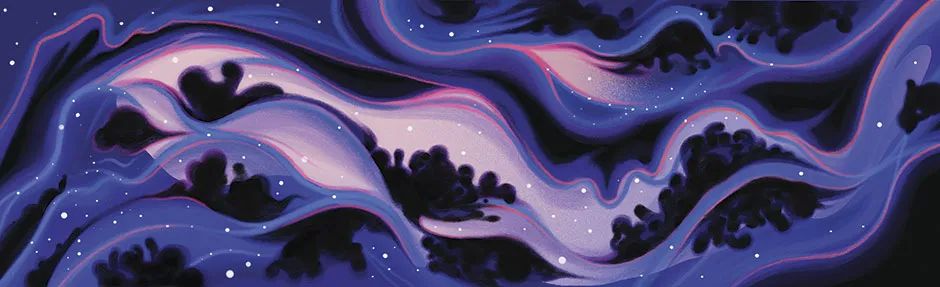
Dark matter gives out no light or too little light for us to detect. We know it exists because we see the effect of its gravity on the visible stars and galaxies. For instance, the Milky Way could not have dragged in enough matter to make its stars in the 13.82 billion years since the Big Bang without there being a lot of invisible matter whose extra gravity speeded things up. The European Space Agency’s Planck satellite found that dark matter accounts for 26.8 per cent of the mass-energy of the Universe compared with the 4.5 per cent of normal ‘atomic’ matter. It therefore outweighs the visible stars and galaxies by a factor of about six.
For a long time, the favoured candidates for dark matter particles have been Weakly Interacting Massive Particles, or WIMPs. But although these particles fit the bill, they have failed to appear at the Large Hadron Collider near Geneva in Switzerland. A candidate gaining favour is the super-light ‘axion’, a hypothetical subatomic particle. A rank outsider remains primordial black holes, left over from the Big Bang.
Puzzlingly, no Earth-based experiment has found any evidence of dark matter, despite decades of searching. It is conceivable that it is not our theory of matter that needs modification but our theory of gravity. Or that dark matter is not a fluid made of a single particle but is complex like the atomic matter we see around us. Maybe the Universe is filled with dark stars and dark planets and dark life!
_________________________________________________________________
Does time exist?
Time is what stops everything happening at once,” said American physicist John Wheeler. But time is a slippery concept. Most of what we think we know is false.
For instance, we imagine time flowing. However, for something to flow, it must flow with respect to something else, just as a river flows with respect to a river bank. Does time flow with respect to something else – a second type of time? The idea seems nonsensical. Most likely, the flow of time is an illusion created by our brains to organise the information constantly flooding in through our senses.
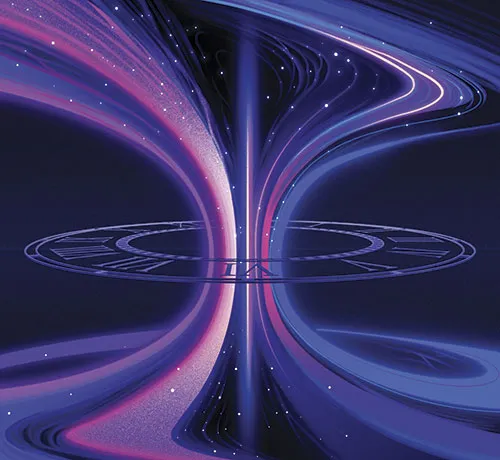
We also have a strong sense of a shared past, present and future. However, the idea of a common present appears nowhere in our fundamental description of reality: relativity. Precisely how someone else’s time is sliced up depends on how fast they are moving relative to you or the strength of the gravity they are experiencing.
These effects are noticeable only at relative speeds close to that of light or in ultra-strong gravity, which is why they are not obvious in the everyday world. Nevertheless, they lead to the idea that one person’s interval of time is not the same as another person’s, and that one person’s interval of space is not the same as another’s.


Comments
Post a Comment